Thursday, 26 January 2012

Main Task - Research and Planning

Here is evidence of our are our first initial ideas and development for a teen horror film. We gathered our thoughts together to start idealising our storyline and came up with several different ideas.


Analysing 'Jennifer's Body' Opening

Trailer to Jennifer's Body -


http://www.youtube.com/watch?v=W1ZKdevSPQg


The scene starts off as what we can tell is outside, as we are looking at the outside of a house, from the garden. The lighting is very dark to represent night time, as the sky is dark and we see a light through one of the windows of the house. The whole mise-en-scene is very dark to also suggest the genre of film we are looking at, which is presumably a horror film.

As soon as the scene starts, the camera pans around a tree, only briefly to view a long/wide shot of the house, suggesting the location of this clip is based around, and maybe in the house. The camera then quickly moves towards the house, using a hand-held camera to show someone walking towards the house, maybe from someone’s point of view. The camera is moving very rapidly towards the house, waiting to reveal what is inside, building up tension along the way. But, before the person actually gets to the window, the camera straight cuts to an extreme close up of someone’s lips.

We can see this character’s lips, teeth and hair, which this character appears to be placing in their mouth. We have no proof that this character is either a woman or a man, girl or boy, but judging by the length of their hair, it could may well be a woman. The camera then uses a straight cut to cut back to the character walking towards the window, and this time we see through the window.
As the camera tilts over the window sill, we look into a room which is pink, suggesting further that this is a girl/woman’s room.

The camera cuts to a basket, and tilts upwards whilst the title ‘Jennifer’s Body’ slowly dissolves onto the screen, in pink. The camera seems to be tracking instead of tilting, as the camera stops midway to start tilting down a little, to view the full body of the character we have been curious about. The audience would assume this is ‘Jennifer’ as straight after the title disappears, we view
a body of a young girl that may well be ‘Jennifer.’ This is a long shot and we can see a bit of her bedroom in the background, pink lights and a picture board. The pink contrasts with outside, as it is dark outside, whereas inside, the pink shows the innocence of the character.


A straight cut to a mid shot/almost close up of the TV which shows what the character is watching, but is almost random as it brightens the mood just a little for a horror film. It is associated with gym and work out training which we can tell the character is not very interested in, as she is lying down, distracted by a book instead of getting up and acting out what is on the TV. The TV is there for a distraction so that if something happens, like in a horror film, it wouldn’t be as scary.


But, as the audience is focusing on what is on the TV, thinking that they are safe from any horror scenes yet, the camera straight cuts to the side view of the character on the bed, also looking at another character through the window which we can also see, realising that this is the character who’s footsteps we were originally following outside. The effect of the dramatic straight cut from
the TV is to make the audience jump, after thinking that the brightness of the TV could prevent something happening so suddenly, which proves the audience wrong. It contrasted from the type of programme we were watching, to the type of film we are viewing. It was unexpected, although the character on the bed did not jump, implying that she had not seen the character outside, and
building up more tension.


Since we have seen the character through the window, there is a close up of the character to see almost a reaction face, as she is looking in through the window. She has a blank expression on her face which makes us question is she bad or good? We cannot tell as she is neither smiling nor aggressively frowning. She continues to wait until the other character recognises her.

However, the character ‘Jennifer’ still does not realise there is a character outside, and we know this because the camera cuts to a close up of the character on the bed, who is still looking down at the book. The camera is at a high angle, looking down on the character to make her look weak and helpless, judging by the paleness of her face. Jennifer then dramatically opens her eyes which suggest she has probably sensed that someone is watching her, or maybe she has seen the person right in front of her. This is where the camera pauses for a while whilst a character uses an over voice to explain what is happening. The effect of leaving the camera paused on the character represents that this is the main character, everything is focused on her and it was maybe a flashback or a point in time where everything changes.

Analysing 'The Roommate' Opening

Unfortunately I cannot find a link to link you to the opening of this film at this current moment as it is only a recent film. It is called 'The Roommate' and is a teen horror film which I will be analysing the opening few minutes only. However, here is a trailer of the film to give you an idea of what it is about.

http://www.youtube.com/watch?v=iVry4ijuUvo

As soon as the scene starts, in the background we can hear the non diegetic sound of music - an upbeat song to help set the mood as it is fun and exciting. It is not depressing and slow like a usual opening to a horror film. We then see a sun rising above a city followed by an establishing shot of the city, which is unusual for a horror film. After shots of the city, we see long
shots of the beach and signs to help us realise this is set Los Angeles. A sign representing 'University of Southern California' gives us the idea that the film is set in and around events at a University. This is a positive start to the film and gives no ideas that this is a horror movie yet as it so far depicts a chick flick. As with teen horrors, they start positive and end in the style of a horror film.


Then comes the diegetic sounds of cars and voices as the character immediately introduces herself to another character in the shot. We assume this is the main character as the focus is completely on her. As well as the close ups of characters and non diegetic music, the titles appear on the screen displaying the actors involved in the film. They are simple and small but easy to read in the left quartile of the screen to remind the audience of the actors involved. Every professional film has the titles of the actors and producers & directors at the beginning or the end of the film, mainly both.
Whilst the music remains playing, the camera tracks backwards whilst the character walks forward into the corridors of the University. This demonstrates more of a teenage movie as the music is still continually playing in the background whilst the character moves in sync with the music. The mise-en-scene shows a dreary background with grey and brown hallways to show that the University might not be a pleasant place to be in, indicating that the film will come with mystery later on.


The lighting is only natural and coming through the windows, which shows quite a dark atmosphere in corners or the room and highlights the drab furniture that comes with the University. This is usual for a horror film as dark and natural lighting represents a dark story suggesting that life is not all bright and colourful. The following mid shot of the character allows the audience to see she is wearing a plain white top. It then becomes more of a typical teenage movie as the character appears outside with many people passing, still hearing the music and representing the busy everyday lives of teenagers at University.


However, when back in her room, she is sitting quietly on the bed, reading and waiting until someone knocks on the door. This is mysterious as we do not know who is at the door. Could it be her roommate? When she answers the door, we see disappointment cross her face when she sees two girls who invite her to a party. Instead of agreeing to go, she decided she wanted to wait for her roommate, suggesting excitement about wanting to meet her new roommate. But then, she is easily encouraged to go to the party, leaving the room dark, empty and unwelcoming for her new roommate, who later is revealed as a mentally confused character. When more is revealed further on in the film, it brings more mystery and horror as we discover the true events of the life of a teenager.

This opening was interesting, because it barely portrayed a teen horror as the opening was styled like a chick flick. This can be misleading and distance the audience away from a horror, shocking them when horrific events are revealed. It is a very successful and modern film
.

Tuesday, 29 November 2011

Main Task - Introduction

Brief: The titles and opening of a new fiction film, to last a maximum of two minutes.

The Genre We Have Chosen


We have chosen to do a teen horror film for our main task. This is because it allows us to use a range of different camera shots and sound as well as offer a wide variety of ideas for the mise-en-scรจne. A horror film gives us an opportunity to show the techniques we have learnt and create a film suitable using the equipment and location necessary. Also, we chose to do a 'teen horror' instead of just a 'horror' which we thought was appropiate and understandable since we are teenagers ourselves. We understand the ideas that would be effective for this type of genre.

Thursday, 17 November 2011

Preliminary Task Evaluation

For our preliminary task, we experimented with the camera to produce a short clip of action. We shot our preliminary task in our school reception area, including a corridor and a meeting room as we felt this was an appropriate location to film our clip. The concept was to have a character distributing a mysterious package to another character, in suspicion, whilst still considering the brief we had to follow. The brief stated that we had to have one character opening a door and coming through the door before crossing the room to meet with another character, and so we fitted our planning around this brief. After completing our planning process, including our storyboarding, we continued to the filming stage since we knew exactly what we were doing and how to use our time wisely.

We started the scene with a long shot of our location, which was clearly a school reception area because of the register rack chairs and rooms. This was a good opening to our clip. It showed Tabby walking towards the camera, and entering a door, passing through the door to meet another character. The other ch444;">
As well as unnecessary people interrupting our filming, the diegetic sounds of voices, telephone ringing, slamming of doors and photocopiers could all be heard whilst we were filming. Although this kept a more naturalistic environment, the voices that could be heard would put the audience off from focusing on the action and so we knew this had to be a part of our editing process. However, when it came to editing, we could not seem to separate certain sounds, long shots and close ups when necessary to focus on location, facial expressions and body language as well as expressing good camera skills in advance, before starting our main task. As we only spent 2 hours filming, it was easy to keep the surroundings and costume consistent as the filming was complete in just one part of the day. However, the only problem we had with filming in a school corridor was that it was busy with people interrupting which slowed down our filming process, taking longer than we had planned as we had to ensure that no-one would walk in.

As well as unnecessary people interrupting our filming, the diegetic sounds of voices, telephone ringing, slamming of doors and photocopiers could all be heard whilst we were filming. Although this kept a more naturalistic environment, the voices that could be heard would put the audience off from focusing on the action and so we knew this had to be a part of our editing process. However, when it came to editing, we could not seem to separate certain sounds from the whole background and therefore just had to quierious about it, as well as the character distributing the package. This, as well as the cookie involved in the package were the only props used when filming.


Even though the film was short, a lot of editing was involved. The editing took longer than the time to film the clip, since we had made many mistakes and had to cut each shot to fit in with the continuity. Fortunately, we did not need any text or additional non diegetic sound in our film and so the editing process was simple. The editing took longer because of the amount of importing we had to do and since the shots were short and sharp, we had to fit the correct shots in order whilst making sure the continuity was smooth to look professional. At the end, since a group of people accidentally walked into our shot, we had to cut them out of the film. We used a ‘fade out’ effect at the end not only to block out the people from walking into our footage, but to demonstrate that our filming was complete, as most movies and television programmes end with a ‘fade out to black’ elope with a ‘?’ printed to indicate a sense of mysterious about it, as well as the character distributing the package. This, as well as the cookie involved in the package were the only props used when filming.


Even though the film was short, a lot of editing was involved. The editing took longer than the time to film the clip, since we had made many mistakes and had to cut each shot to fit in with the continuity. Fortunately, we did not need any text or additional non diegetic sound in our film and so the editing process was simple. The editing took longer because of the amount of importing we had to do and since the shots were short and sharp, we had to fit the correct shots in order whilst making sure the continuity was smooth to look professional. At the end, since a group of people accidentally walked into our shot, we had to cut them out of the film. We used a ‘fade out’ effect at the end not only to block out the people from walking into our footage, but to demonstrate that our filming was complete, as most movies and television programmes end with a ‘fade out to black’ effect.


From watching back over our finished footage, we noticed small improvements that could be made. We could have been more aware with our sound at the beginning and end of our filming since there were unwanted sounds that had been captured. Also, there were some slight pauses in transition between a numbers of shots which could have been sped up so that we would not notice these. This was due to moving the different shots around and experimenting with the continuity. However, we did use the 180 degree rule, reverse shot and match on action in our filming and therefore successfully produced our preliminary task, to our standard. Although there are improvements that could have been made, we experimented with using camera and are proud of our work so far.

Wednesday, 16 November 2011

Sunday, 2 October 2011

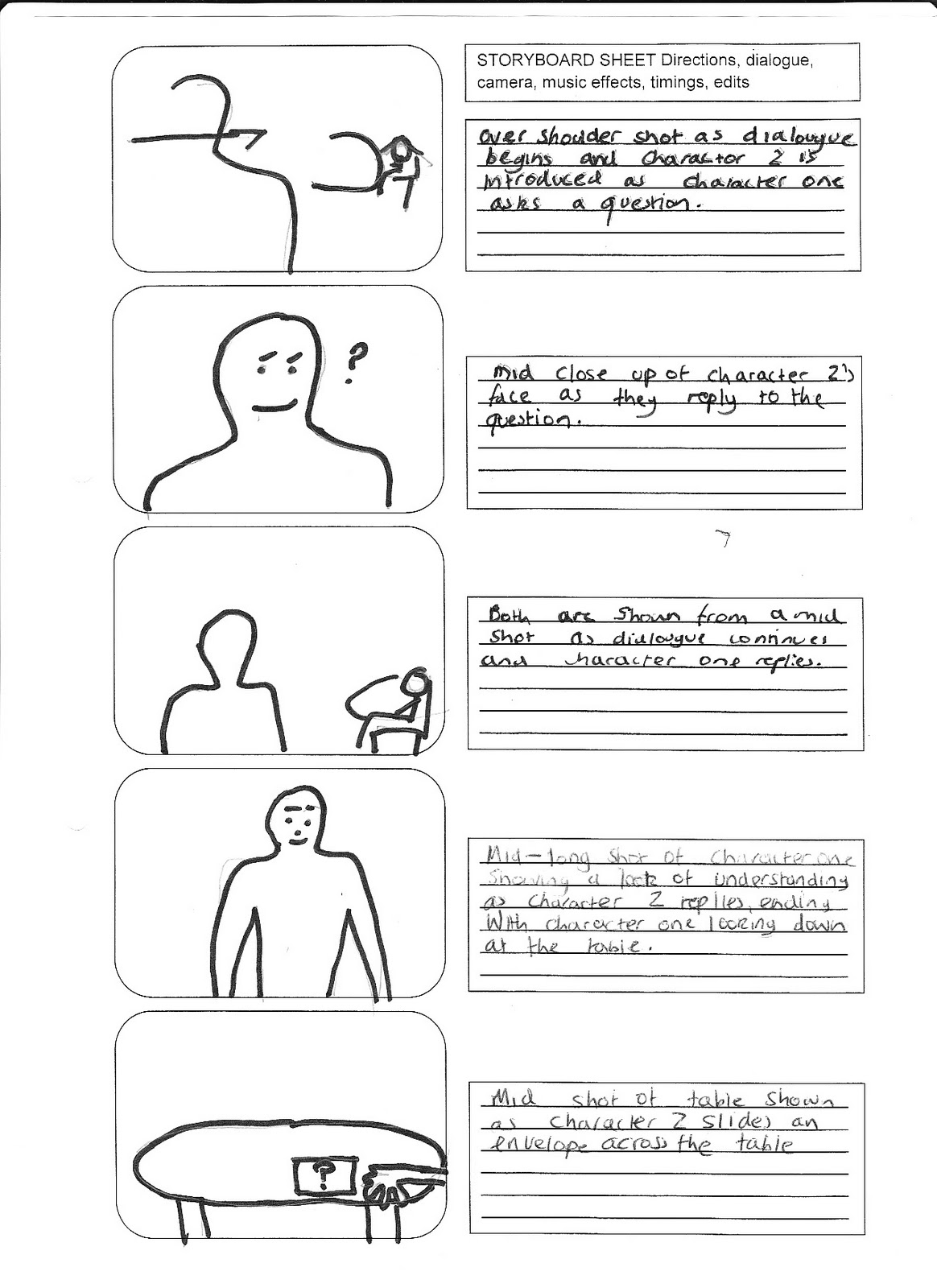
Preliminary Task Storyboard

Together, our group devised a storyboard to plan our preliminary task. We drew brief images alongside an explanation of the shot, containing information about the angles, types of shots and what will happen in the shot.

This is our completeted storyboard...